The Beats were non-violent. They were branded by the press of the time as delinquents, but in real life the beats packed most of their excess power into sexual liberation and self-expression, not pugilism.
*****
Maybe we didn't get to hear enough about the women of the beat generation because Kerouac's references to single women living on their own in late-1940s New York City were cut by the publishers from his first novel ("The Town and the City," 1950).
*****
What Works on Which Drugs:
"Tristessa" by Jack Kerouac, 1960 ... morphine
"Magic Psalm" in "Kaddish" by Allen Ginsberg, 1961 ... ayahuasca
"Nova Express" by William Burroughs, 1964 ... heroin
"Wales, A Visitation" by Allen Ginsberg, 1967 ... LSD
"Guilty of Everything" by Herbert Huncke, 1990 ... heroin, marijuana, benzedrine
*****
"Standing on the street corner waiting for no one is Power."
*****
"Poetry is the shadow cast by our streetlight imaginations."
"Death is the mother of the Universe."
"One room is all I'll ever own in eternity, one bed -
memory
ramblings
over tall mountains carrying me away to that nomads
land."
from "Writing Poems Is a Saintly Thing"
Top beat sounds:
* “Raindrops in My Coffee” by Sexsmith & Kerr, from “Destination Unknown" (song included in "Radio Bob: Dylan’s theme Time Radio Hour" CD)
* From “Instant Karma: To Save Darfur” - Sierra Leone’s Refugee All Stars’ “Give Peace a Chance,” also Regina Spektor with “Real Love” and Jakob Dylan and Dhani Harrison on “Gimme Some Truth.”
* "Nus Gniik" from the Beatles' latest, “Love.”
*****
The words all in caps in Michael McClure's poetry "never mean that the lines are shouted or that they are chanted," explains the poet. The capital letters are a "disruption of the allure of the poem and a reminder that it is a made thing ... Later I experimented with using the lines of capitals to signify a small shift of intensity in the voice or mind ... The lines of capitals at the opening of the poem came to signify the quality of energy with which a poem begins."
Much of McClure's verse is centered - not so common a practice in the years before word processing. ("By 1955 I began centering poems so that it would be clear they are the stuff of consciousness" - 1991.)
*****
"Jack Kerouac is not for prudish persons. His 146th Chorus'(I almost said Canto, and he does find it hard to get away from the manner of Pound's Analects and Cantos) has unity, a tune, and the feel of the mountains. Allen Ginsberg can foul the nest in a way to marvel at, but it is an innocent enough picture of himself. Gregory Corso has vehemence."
Since the War," a review of Donald Allen's "The New American Poetry:
1945-1960" in The New York Herald Tribune, 26 June 1960
*****
Last words of the 242nd, and last, Chorus of Kerouac's "Mexico City Blues" -
with nobody
To save the old man being hanged
In my closet for nothing
And everybody watches
When the act is done -
Stop the murder and the suicide!
Saturday, December 1, 2007
GleeNinGs

Sunday, November 11, 2007
A Record Number of Awards
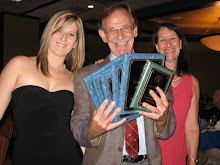
Mark Howell, of Abouthebeats.blogspot.com and Solares Hill, seen here with his stepdaughter Melissa and wife Jan at the Excellence in Journalism awards ceremony in Fort Myers, Fla. on October 20, picked up an unprecedented five first-place awards and one second award from the Florida Press Club this year. The awards are for General News, Government News, Serious Feature Writing, Public Safety Reporting, Criticism Writing and Health Writing. Yet none of this writing has served to bring an end to the war or put a stop to Blackwater, so "I'd rather be safe in heaven dead." (JK)
Read More...Saturday, October 13, 2007
A Bibliopolist’s Lost Apocalyptico (Jack Kerouac once told Carolyn Cassady that his clientele was "kids who steal my books")
“Can heaven be near?”
Exuberance made me ask it, my eyes dancing down the shelves that swept to the back of the store. Surely, in this leafy little lane, the foothills of Paradise began.
“Say again,” said the man at the cash register.
Ridiculously I repeated the question.
The wooden panel behind him slid smoothly aside. “Go on,” he said. “They’re waiting for you.”
I stepped into darkness, then down two steps and through to the dim light of a low room. Sitting at tables were what the trade used to call bibliopegists — men and women restitching the spines of books, retooling the leather covers. The place smelled of chemicals.
“Are you the new book thief?” asked one of the women. “What you got for us, then?”
So began the first chapter of my manuscript, “The Book Thief,” begun a few short years ago at a retreat in the Georgia woods. Guess what? Someone else has since come out with a book called “The Book Thief.”
My “Book Thief” was intended to be short and sweet. Markus Zusak’s “The Book Thief,” published by Knopf, is almost 1,000 pages long and about the Holocaust.
Down the tubes went my own effort, taking with it a story that had curiously prophesied its own downfall — as it should, if it’s really about stealing books.
Suppose the “I” of the story, the fellow who went through that secret door, had stumbled on an operation that supplied just one person in the world with treasured editions of all the greatest books, neatly restored and rebound. My purpose was to address what Henry James hissed about, namely “the black and merciless things that are behind great possessions.”
But as it progressed, things happened to my tale. Suppose the “I” character was easily recruited because he needed the cash to look after his 9-year-old grandchild who had recently and reluctantly (on the child’s part) come into his care. Suppose the child, exhibiting exceptional talent, sold the story of her grandpa’s career as book-thief to a tabloid. What a courtroom scene that would make! Man and child, they love each other to death and now must execute an extreme escape. Then what?
A character’s character is revealed in his or her motives, so to answer that question I needed to grapple deeply, not only with what makes grandparents and grandchildren tick in tune (or not), but with what makes people love books rather than each other. Or collect books rather than read them, stealing books only to collect them.
The amateur shoplifter does not have the motives I sought. Nicknamed a “booster” by professional thieves, the light-fingered bookshop prowler is in it for the chase, a matter of opportunity. Capturing the object of desire is the least of it, especially when the booster realizes he will not have acquired the time to read the damn thing simply because he’s liberated it; some shoplifters take their loot back. These folk are motivated by unresolved issues (“It’s there for the taking,” or “I deserve it”).
The most outrageous rationale for kleptomania is the one that says it’s not really yours to begin with so let’s have it. This will extend to the klepto’s relationships: “After when they disentwine/ You from me and yours from mine/ Neither can be certain who/ Was that I whose mine was you” (Robert Graves).
The professional thief who makes a living by selling stolen stuff is also not motivated in any way useful to my story. Forest Tucker, famed larcenist of the 1930s, explained that “stealing is a way of keeping your sanity in a lifetime of being the hunted. Each new joint is a place to outwit the authorities” -- too dialectical for the emotional range I was after.
But collecting books, hoarding them, is a rage of a different order. This is the rage for order. It is a drive to conceal shortcomings, including the need for order. The condition is made worse by the nature of acquisition, which is addictive and which conceals the truth even more fiercely. Addicts are in a slow burn at helplessness, at being left alone, and they will condemn themselves to a lifetime of withdrawal and solitude. which is so strange.
The murkiest of all motives for a book thief is an unconscious need to rub out the word. Now that’s more like it. The idea of one person hiding all the first editions of all the great books in the world is an echo back from the future, when the question is what happens when all the computers on the planet are unplugged and illiteracy returns. Would that be so bad?
For writers, who have much more difficulty with writing than other people, t'would be bliss indeed. For society it could spell final relief from the toxicity of what novelist John Gardner called “creating art’s effects with the daemonic help of older books.”
I spent the rest of my rural retreat reading some of those daemonic books. I made notes and I jotted down quotes. The accumulated paper trail soon began to tell a tale of its own, a scroll of other people’s thoughts that started with the usual drooling over books, continued through the hanging participles of Babylon until, too late, the languid reader saw the Word turn into the carapace of the Book. Within an eon or two, religion being simple but theology tricky, the verbs had gone viral.
But then there’s Kerouac. His quote on himself as writer is one of the strangest in all literature.
So here we go ,on my bibliopolist’s lost Apocalyptico.
“O my darling books! Others may buy and possess you — persons, perhaps, less worthy of you than I — yet how dear to me are you all! Have I not chosen you one by one, gathered you in with the sweat of my brow? I do love you!”
— Silvestre De Sacy
“Pearls were poured upon the poets, in keeping with the teaching that poets are next to the angels. Wealth began to accumulate from trade arriving from all directions. A method of making paper from flax and hemp appeared, and the new technology produced books in quantities inconceivable before. Within 40 years, Baghdad was a city of booksellers, bathhouses, gardens, game parks, libraries. The palaces were of marble, rare
woods, jade and alabaster, with carpets and wall hangings, fountains and interior gardens. Concubines greeted guests with sprinklers of rosewater and powdered musk and ambergris. A poet wrote: ‘Live, Oh live to thy heart’s content!”’
— “A History of Baghdad”
True collectors, like lovers, have an infinite sadness, even in their happiness. They know they can never put the world under lock and key in a glass case. Hence their profound melancholy.”
— Anatole France
“The word is now a virus. The flu virus may once have been a healthy lung cell. It is now a parasitic organism that invades and damages the central nervous system. Modern man has lost the option of silence. Try halting your sub-vocal speech. Try to achieve even 10 seconds of inner silence. You will encounter a resisting organism that forces you to talk. That organism is the Word.”
— William Burroughs, from “The Ticket That Exploded”
“Ah, my love, the glory of works which have been lost forever, of treatises which today are mere titles, of libraries which burned down, of statues which were demolished! How much more beautiful the Mona Lisa would be if we couldn’t see it. And if someone were to rob it just to burn it, what an artist he would be, even greater than the one who painted it! How sublime to waste a life that could have been useful, never to execute a work of art that was certain to be beautiful, to abandon midway a sure road to victory.”
— Fernando Pessoa
(“The Book of Disquiet”)
“I am not Solomon; I am he who watches the Lamb; I am he who has adopted the Sorrows; I am he, John L. Kerouac, the Serious, the Severe, the Stubborn, the Unappeased; he who is pursued by the Hooded Wayfarer; he who wants Eyes; he who Waits; he who is Not Pleasant, and hears Silences; he who Works; he who Watches, and has Hidden Thoughts; he who Grinds the Stone and even the faces — with Eyes.
“He who is not Satisfied.
“He who hates Satisfaction.
“He who loves the White Valley of the Lamb.
“He who Eschews, and Waits, and Watches, and Sleeps, and Works in Anticipation of the Lamb, the Lamb so Meek on the
Mountainside.”
— Jack Kerouac (Journal, 1947)
“Reading these lines I can easily convince myself that I am inking down the words, that I am this Jack Kerouac. It is as if, hidden somewhere in his book, there is a writing that hasn’t been written yet and will never be finished. Recently in a dream I tried to convince him to release some of his unpublished writings, or persuade his widow to release them, but he answered, refusing, ‘writing settles nothing.’”
— Clark Coolidge
(“Now It’s Jazz”)
Sunday, September 30, 2007
The Key West Interview: Lawrence Ferlinghetti, 1994
 by Mark Howell
… “Watchman, what of the night?” …
“Seeking refuge from the anxieties of the modern age, much amplified by amplification”
Lawrence Ferlinghetti came to Key West in March 1994 for his first visit in more than 50 years. He was 75 when he gave us this interview plus some unpublished poems. He had just celebrated his birthday in Jacksonville, Fla. with his daughter Julie. His son Lorenzo was “joining the working class” as an arborist in Bolinas, Calif. Their mother, the poet explained, was Selden Kirby-Smith, granddaughter of the last southern general to surrender in the Civil War. The subject of Kerouac came up soon enough ...
Lawrence Ferlinghetti: One of the bonds Jack and I had was that we both spoke French with our mothers. When Kerouac went to France he was very paranoid about his Quebecois accent, which of course the French put down like he was a country bumpkin. So Jack was really very unhappy when he went to France, he ended up drinking more and more. The French are so snobby about their language.
Mark Howell: How French are you?
LF: My mother was French-Portuguese-Sephardic. She was actually born in Providence, Rhode Island, but her family had left Portugal during the Spanish Inquisition, gone into France for a couple of generations, then took a Danish crown colony expedition to St. Thomas in the Virgin islands. The graveyard in St. Thomas is full of my mother’s ancestors. When I was born my mother had a complete nervous breakdown. My father had died before I was born, she had five sons and I was one too many. She went into a mental hospital, so her French sister took me to France. When I came back to this country with my French aunt, she disappeared. I used to write her letters, it was the first writing I did, like Anais Nin writing to her absent father. My own father was from northern Italy, from Brescia. Ferlinghetti ain’t Irish.
MH: Kerouac called you Monsanto in his novels.
LF: My mother’s maiden name. Another bond I had with Kerouac, we were both Thomas Wolfe fans. Essentially Kerouac had the same sweeping vision of America that Wolfe had, a pre-World War Two America that no longer exists today except in forlorn, lost, dusty old Greyhound buses stations in the outback.
MH: Your own first novel, “Her,” did anybody influence you on that?
LF: I wrote it in an extraordinary mood. My sensibility in the Paris of 1948 was a very strange one, perhaps mood is an understatement. It was very much affected by Djuna Barnes’ “Nightwood,” which is one of the great books of American writing. The heroine is Robin, the lady with the cape. She’s searching Paris for a woman she’s in love with. She goes from café to café and ends up visiting an Irish expatriate alcoholic transvestite, surprising him in bed wearing lots of lipstick and a very beautiful costume. She says to him in a distraught state, “Watchman, what of the night?” and he starts in on this monologue that is some of the most beautiful prose in all literature. I once told Djuna Barnes that I thought she wrote a man’s prose. I wouldn’t have dared say that today. But she said she considered it a high compliment.
MH: Is there something wrong with men these days?
LF: I think the American male today has generally been raised by a woman because of the large number of homes where there’s no man around. Men have been raised to please women, and they tend to abdicate their masculinity in order to please women. It was much worse before. The man did what he was gonna do and the woman had to trail afterward.
MH: How goes capitalism?
LF: Capitalism is the most wasteful form of economic organization that you could possibly have. Capitalist organizations are spreading out all over the world, and you’ve heard their motto: “Think globally.” Well, they’re thinking globally of where the cheap labor is. They’re in a race to the bottom, rushing to the country that has the cheapest labor.
MH: You always refused government hand-outs to you or your press?
LF: I don’t see how one can take money from a government that has been killing millions of people overseas in illegal wars.
MH: Did you ever think that you might not prevail?
LF: When I got started in San Francisco and we opened City Lights bookstore in 1953, it was the height of the McCarthy era – or error. Freedom of expression was really under attack. We were busted for publishing Allen Ginsberg’s “Howl.” I mean, we were just a little one-room bookstore with no resources for legal aid, and it would have sunk us if we hadn’t had the ACLU to defend us for free. Freedom of the press is a continuing battle in which every victory is temporary.
MH: What was the high point of the 1960s for you?
LF: When I put on my beads and went to the Filmore and started dancing. The first time I took LSD wasn’t necessarily my high point of the Sixties, but certainly LSD was the high point in the liberation of consciousness. That part of the revolution did happen. What didn’t happen was a political revolution, which was aborted by the troops at Kent State. And by a general absorption into the middle class of the many Sixties heroes, especially in the musical world, who became so successful and rich that they were ingested into the system.
MH: You are an exhibited painter these days.
LF: Painting is a bride of sorts. It’s more of a – what’s the word? We can’t carry this analogy too far, I’ll get into trouble. Painting is more demanding than most wives, and very uncompromising. You can’t get away with anything with this bride, the bride of painting. That’s a good line.
MH: How about Kerouac?
LF: Jack’s first book, “The Town and the City,” is I think a much greater book than “On the Road.” It was the book he wrote before he was infected by the beat virus and it was modeled on Wolfe’s “Look Homeward Angel.” Kerouac had the same sweeping vision of America that Wolfe had, a pre-World War Two America that no longer exists today except in forlorn, dusty old Greyhound bus stations in the outback.
MH: And America?
LF: Inasmuch as the empires of the world have been crumbling – first the French empire went, then the British empire went, then we watched as the Russian one went – now it’s our turn. The American empire is going to disintegrate. I feel that in the 21st century we’ll have more and more secessions. San Francisco never did consider itself a part of the United States. I think Key West has a great idea. Good luck to the Conch Republic.
MH: This is your second visit to Key West?
LF: I was last here half a century ago, in 1943. It’s hard to believe. It was like Hemingway’s Key West back then. We were at the Navy base on escort vessels, and going to submarine school to find out how submariners thought. We went down in submarines here. I think we only stayed six weeks, maybe two months. We ended up spending a good deal of time at the Carline Street house of Jesse Porter Kirk, through a buddy of mine in the Navy who was a marvelous piano player. He played ragtime, he played South Pacific music, he was great person to have at a party. Jesse would invite us to every party she had at her gorgeous house.
MH: Didn’t you invite Jesse’s daughter Jeanne out on a date last night?
LF: She was nowhere to be seen. I think she was 16 when I first visited here, just running around the house and the garden, skipping. A whole bunch of us did go out last night, but I think Jeanne had retired already. We went to a very noisy bar up the street and stayed about 10 minutes. You know, tourists could be weaned from the electronic age if the city of Key West became known as the one place in the whole of the United States where you could go and hear nothing but pure, non-amplified music. We pollute Caroline Street with electronic music. The hope is that some electronic angel will make our ears mutate so we don’t hear this awful racket. People who are seeking refuge from the anxiety of the modern age, which is much amplified by amplification, would be able to come down here as a last refuge. Key West could become famous for that. The last refuge.
Ferling Ends Up in the Cemetery:Four Key West Poems by Ferlinghetti
Done Wrong
[Writ at Heritage House, Key West Republic, March 26, 1994]
She calls me from a pay phone
outside of a filling station
outside of Paris Texas
I can hear the countrywestern singer
on an old car radio
singing She Done Me Wrong
I’m calling to tell you I done you wrong honey
she sings out to me on the phone
and hangs up
I rush out of the filling station office
and find her just escaping
the phone booth
we throw our bodies ’round each other
and live unhappily ever after
Three Key West Poems
[Writ in Key West, March 28, 1994]
#1
Great breakfast at Pepe’s …
Over-age beachboy
in broken down running shoes
seats me in a booth
In comes a couple of Miami bimbas
in pink shorts pink sunglasses
and pink breasts
the latter very prominent in very
pointed bras
The beachboy steps back a bit
and seats them at the next table
fanning himself as he walks away
They study the menu
no doubt looking for fried shark
And I am a camera
fixing them in the emulsion
of my eternity
#2
Key West’s cemetery …
A total of seven stone angels therein
The small ones like cherubs
with pathetic little wings
which couldn’t possibly
carry a soul away
One big beautiful white angel
with the end of one folded wing
broken off
I think of Thomas Wolfe’s stone angel
And of “a stone a leaf an unfound door”
Still unfound
forevermore
#3
And there is a great plaster laughing figure
Standing on a raised tomb
His head too large for his body
and his left hand pressed to his stomach
as if he had a sharp pain or were just about
to double over with mad
uncontrollable laughter
He has a weird grin on
his stoney face
With his foot on the head of his son
resting just below
I hear a faint crying
from a hundred years ago
Stoned With Cassady, Stoned with Kesey: Robert Stone on the Sixties
 by Mark Howell
(“If you don’t go to the edge, the edge will come to you.”)
Robert Stone and his wife Janice have been married for 47 years. At their bungalow in Key West earlier this year, the night watchman sat with Bob over a cup of tea to reminisce on their remarkable life together.
He was born in 1937, in Brooklyn, the only child of Gladys, a single mom and a schoolteacher, herself the daughter of a tugboat captain and raised on Park Avenue when it was still the railway into the city. Bob grew up where Lincoln Center is now.
He dropped out of high school, long division being beyond him, in favor of reading and “goofing.” By 1956 he’d joined the Navy, in under 18 and out at 21.
After a trip to the Antarctic as something called Journalist First Class, he found himself a civilian in New York. There he met Janice, who had a day job but was a nocturnal beatnik, the archetypal beat girl who changed at dusk into the black stockings, skirt and sweater required of a night in the Village. When she got a job at the Seven Arts Gallery, the pair was introduced to the painters and poets then remaking America’s sensibility.
The couple would have two children, their daughter Deirdre and their son Ian, born just after President Kennedy was shot. But first the honeymoon, which they spent in New Orleans. It was in the deep South that Bob found his first post-sailor job on an assembly line; he was soon terminated for “attitude.” His vilest job at that time was census taker, forcing him to question people about their lives as they sat around a deathbed, for example.
It was in New Orleans that Bob Stone began work on a novel eventually published in 1967 as “A Hall of Mirrors.” It was an endless stint in the salt mines — “I really thought he would never finish it,” says Janice today — although Bob recalls the ordeal as nothing compared to the civil rights sacrifices of Viola Liuzzo or Mickey Schwerner. It was his writing that won him a fellowship to study with Wallace Stegner at Stanford University in Southern California, a life-altering opportunity that incidentally exposed him to the mind-altering powers of peyote and lysergic acid diethylamide.
In his latest book, “Prime Green” (2007), Stone recalls how he and Jan and their friends, on trips to San Francisco, would ingest a loathsome, dinosaur-colored ratatouille of peyote-cactus meat in order to enjoy John Coltrane at the Jazz Gallery and Lenny Bruce at the hungry i (sic). “On peyote there are no metaphors,” writes Stone. “The Great Lizard of the Dawn of Time” is exactly that, providing all with “a grinning rictus of terror.”
His first dose of LSD came from an atomizer spray provided by Richard Alpert Ph.D., now known as Baba Ram Dass, who got the drug from a Dr. Vic Lovell to whom a hospital orderly named Ken Kesey would one day dedicate “One Flew Over the Cuckoo’s Nest.” Acid was everywhere at Stanford back then because the Department of Defense supplied it to the university’s Research Institute, from whence it found its way to the Palo Alto Veteran’s Hospital. What is now the work-obsessed Silicon Valley, reveals Stone, back then was a playground for Homo ludens.
On thing led to another, specifically to “the world’s greatest driver, who could roll a joint while backing a 1937 Packard onto the lip of the Grand Canyon.” This was Neal Cassady, hero of Jack Kerouac’s “On the Road,” famed for his supernatural skills at the wheel, driving flat out through rush-hour traffic and impregnating a librarian or two as he did so.
Cassady performed what Stone calls “an uncanny reverse homage” to “On the Road” by traveling east on Eisenhower’s new Interstate system to attend the 1964 New York World’s Fair. The vehicle was “Furthur,” a day-glo painted school bus that carried Ken Kesey and the Merry Pranksters into all kinds of craziness. “A Vote for Barry [Goldwater] Is a Vote for Fun” went the banner on its side.
The Pranksters’ other destination in New York was the West 97th Street apartment of Bob and Janice Stone, who had moved to the city where Bob took jobs at The Daily News (“Marines Mash Cong in Mud”) and at a lesser tabloid, the National Mirror (“Skydiver Devoured by Starving Birds”). It was at the after-bus party at the apartment that Kerouac made a legendary reappearance from his alcoholic stupor to meet the hippies, afterbirth of the beats. Stone thought the King of the Beats might be an impostor, like another fellow at the party purporting to be Terry Southern who most certainly wasn’t. When Bob tried to bum a cigarette, the surly Kerouac told him, “You should buy your own smokes.”
Then it was off by bus to Millbrook, in upstate New York, to meet Timothy Leary and indulge in a multitude of drugs “unrivaled until the prison pharmacy at the New Mexico state prison fell to rioting cons.”
Of Kesey, Stone writes that he was a “libertarian shaman, fearless friend.” Elders among the Pacific coast Unitarians had taken to calling him God because of gnomic Kesey utterances like, “If you’ve got it all together, what’s that all around it?” The year following the Merry Pranksters’ trip across the nation, written up by Tom Wolfe in the Sixties’ bestseller “The Electric Kool-Aid Acid Test” (though Wolfe did not ride on the bus), Kesey was busted twice for possession of narcotics, first in La Honda and then in San Francisco — just as Cassady had been busted, six years earlier, for selling a couple of joints to a pair of narcs and serving two years in San Quentin although already a world hero for “On the Road.”
Stone was dispatched by Esquire magazine to find Kesey, who with his wife, Faye, and the kids had fled to Mexico before his trials. Hiding out on the western coast at Manzanillo, Kesey and friends took long walks on the beaches. This was but four decades ago, yet there was not another person to be seen, let alone a house. In Manzanillo “we had ourselves an opera,” writes Stone, sometimes “a Marvel comic.”
At this point in his life and times, Neal Cassady considered it “liberating to restrict his diet to methamphetamine,” reports Stone. “He never ate, never slept, never shut up, nor did his parrot, Rubiaco.” (The parrot would outlive Cassady by 25 years, startling Bob and Janice and Kesey and Faye by spouting pure Cassady one fine morning in Oregon: “Grand theft auto! I tell them that ain’t my beef!”
During the Esquire visit, on the anniversary of Mexico’s independence, Cassady shot up a suckling pig with a hypodermic full of LSD topped off with methedrine, a memorable experience should anyone have been able to remember it. Twenty years earlier, Cassady and Kerouac had found Mexico “a garden without so much as the shadow of a snake.” But that’s not what Stone and Kesey saw. The chapter in “Prime Green” on Agent Number One, a Mexican narc who haunted the American visitors in 1964, was published in the New Yorker and extensively quoted in Solares Hill’s “Soundings.” To Stone, that agent represented the beginning of pot prohibition, the end of liberation.
Later that year, Bob and Janice headed to Paris, where they met a fellow hipster, Michael Horowitz (whose daughter is Winona Ryder), then on to London. Fame and fashion now tumble forth from “Prime Green” as the author recounts the pre-dawn call from Paul Newman (then 44) to buy the movie rights to his first book, also the visit by the Hell’s Angels to the Beatles’ headquarters on Saville Row, plus a journey to Vietnam to cover the war. By the 1970s,” he says, it was “no longer cool to be unhip.”
Throughout these adventures, Stone characterizes himself as the demure, even timid one compared to front-line Pranksters such as Ken Babbs, a Vietnam vet whose commanding voice over the bus speakers would put cops to flight, and the insanely attired George Walker. It is a characterization confirmed by his distant experience as a waiter in Calais, Maine, where the restaurateur told Stone never to work in a restaurant again because he “brought some kind of strange atmosphere to people’s dinner, a fateful tension or pessimism about dinner and life.”
Heroic or not, his place in the Sixties — a period he identifies as “the postwar withheld,” when the wheel of time became visible to all — is central. A time of magical coasts and holy mountains, it was also an era of social integration, of integrating into a new society, of integrity in the individual. There are plenty of “who knows?” in his memoir, conclusions like “We won a little and lost a lot, depending.” On the one hand, he writes, “Maybe I believed that if you worked at it right you could have all the lives you wanted at once, all the loves, all the lights and music.” On the other hand, “We couldn’t imagine it at the time, but we were on the losing side of the culture war.” Because of people like Agent Number One, “The prank was on us.”
Stone’s final conclusion is chilling to unreconstructed hipsters everywhere: “We regret nothing except our failure to prevail.”
Writing this story about Robert Stone is to write the story of my life, in more ways than one. Although he is all of seven years older than I am, our lives have almost intersected more than once.
A few years after he lived on Clark Street in Brooklyn, I lived a few blocks away on Henry Street. While the Pranksters came from California for the New York World’s Fair, I came from Wales for the same purpose. As the Stones crisscrossed the country in the mid-Sixties, a friend and I crossed the country masquerading as two of the Stones. We both worked in tabloids. And we both acquired legal prescriptions, in London, for tincture of cannabis.
This last mention snagged Stone’s acutest attention. “Did you know George Andrews?” he asked. George Andrews, whoa! He was the author of “The Book of Grass” and I helped publish his “Drugs and Magic.” We agreed that Andrews, in Stone’s words, dwelt at the core of “strangeness and criminality.” Once again, Bob Stone — as he had with Kesey, Cassady and Agent Number One in North America — zeroed in on the heart of the matter, London wise. “I’ve been very lucky,” he told me. “For every great moment, there is confusion. That is where I served.”
One other intersection in our lives is the most direct one. When my son Rafael was born in 1971, I slapped the name Cassady onto the birth certificate as his middle name, a defiant gesture in the belief that Cassady would always prevail — and I (like Rafe) regret nothing.
But the question remains, has Cassady, who died of a heart attack at the age of 41 while counting railroad ties outside of San Miguel de Allende, truly prevailed?
To date, Cassady has starred in seven Kerouac novels and one Robert Stone novel (“Dog Soldiers”), also in books by Ken Kesey, Hunter S. Thompson Tom Wolfe, Charles Bukowski and Alan Harrington, plus five biographies, six literary studies and collections of letters, four movies that include Stone’s co-scripted “Who’ll Stop the Rain” directed by Karel Reisz (with Nick Nolte, who has twice acted as Cassady) and, not least, in a Grateful Dead song.
All of the above items are still available to the public, all are big hits on Amazon.com. So, can it not be said that Cassady, despite the drugs and the madness, has prevailed?
I personally received my first copy of “On the Road” in 1960, from my English teacher at school. Bob Stone received his in 1957, from his schoolteacher mom. Stone said that he could not at the time believe that “anyone, anywhere, ever talked” like Neal Cassady in that book, but he was wrong,” and, as they say, be careful what you wish for.”
To give a taste of what Bob is talking about here, I have transcribed two Cassady quotes from a couple of sources, one a rare film moment of the Adonis of Denver, the legendary Hero of the West, tossing his eternal railroad hammer.
The first burst is about changing a fuse on the Prankster bus: “The secret of the fuse is to think of the soul and not the ego. It took the Red Chinese years to discover swallowing tadpoles by the dozen doesn’t make for effective contraceptives.” Now this from the film footage: “I washed my hair and it shrank. Natural catastrophes are happening everywhere, all forms are dead, all forms are known. Life goes where the forms are. It’s already too late, the Pentagon’s doing it deliberately as far as that goes. Enjoy it.”
Tell me, I asked Bob, something I don’t know about Cassady.
We moved to the kitchen to check if the water had boiled for our tea. It had not. “It’s like we’re at a great altitude,” he said. I said we probably were.
“I’ll tell you this,” he said. “It was a workout to listen to him. One of his passengers on the bus, Jane Burton, she said she wouldn’t have stayed on it for a single day if she hadn’t lost her purse. Neal was a kind of good-natured thug. He was not tall, he was a car thief. To do Cassady best on the screen you’d need Robin Williams as Popeye. Muscles popping, bragging out of the side of his mouth —Neal was Popeye.”
We had our tea and we came down to earth. “Everything comes to an end,” said the novelist. History’s narratives, he concluded, are already being revised to suit “our sorry times.” In Stone’s estimation, the nation has now handed over Presidential power to “a completely unqualified person who is influenced by men who have never doubted, who have no sympathetic imagination. I don’t know if we’ll ever come back from this.”
Have, then, the lives of disaffiliation and experiment conducted by him and Janice (let alone by me or my wife Jan — amounted to naught?
Ah, he replied, that’s not the point. Not the point at all.
“If you don’t go to the edge,” he explained, “the edge will come to you.”
“Milky Ways Across the Night” - Kirby Congdon, Born to be Beat
by Mark Howell
...from “The Cat’s Story” by Kirby Congdon
All living things are born
To be canned as cat food.
But we don’t can people
Because people have can openers
And, so, are useful.
All animals have their uses.
A cat, however, does not need to be useful.
He is born a cat, he stays a cat, and he lives forever.
Any cat is the oldest and wisest
And the most beautiful creature
In the whole animal kingdom.
Be thankful you’re a cat.
I first met the cat called Kirby Congdon in an alley called Appelrouth Lane. Back then it was a bopping place of poetry and the neo-beat life, and the very first time he turned up for a reading we almost missed him.
I was racing up the lane to retrieve Harry Calhoun, who’d checked out of our opening night at the Appelrouth Grill by running away and I don’t blame him. I felt he should take another shot. At least another shot of tequila from an upturned shot glass, snorted up the nostril.
That was then. And blow me if we didn’t get back to the grill to find it packed with poets, among them Kirby. “Milky ways across the night,” he told us, “are what this world is all about.”
Kirby was a cool, flustered guy in blue shirt and leather pants, with a huge motorcycle on the street outside. “Wild, nameless, untamed” was another line of his.
He was different from the rest of the poets. In the limelight his face was a parchment with a photo printed on it of a poet from the nightclub called the hungry i. He looked sharp and he seemed kind and we loved him right away.
“Then I go the other way,” he said of the way he trips the listener.
I had an inexpressible question of the beats at the time but it went unasked of Kirby because I had no real idea of what the question was. Maybe later, I thought.
Todd Swift, a book reviewer in England, once called Kirby avant garde “only by virtue of being completely unknown.” Of the anthology in which Kirby appeared, Todd said, “Never have I seen an uglier front or back cover. It bears every resemblance to the smallest of smallest publishing ventures. For that reason alone it merits a nod of respect.”
I’ll give him that nod of respect, and to Louis Weingarden too. Louis was the composer whose “Inquiries of Hope: Ten Poems of Kirby Congdon” is the earliest musical composition to address the epidemic of AIDS. Louis owned a boot shop and erotic art gallery on West 4th Street in New York City, where he exhibited Robert Mapplethorpe and Tom of Finland. In the summer of 1978, Louis organized a group of leather men called SMASH (Society to Make America Safe for Homosexuals). Where Louis was, you could find God. You could find God where the leather men were. Kirby was a leather man.
He started it. At 18 he had joined the army for three years, then went to Columbia on the GI Bill. He went out one day and bought a motorcycle and the leathers to go with it. Leather was a release, he explained, especially for army veterans “old enough to express themselves.”
Kirby has written of industrial machinery, motorcycle fantasies, heroes from the comic strips, rural Connecticut and cats. I never did talk with him about God or about that question I had.
The big book we all associated with Kirby’s was one of his first, “Iron Ark: A Bestiary,” a wholly original work that e.e. cummings found attractive and Marianne Moore liked as well. But the New York Times failed to review it – too original – so Kirby was assigned to public obscurity.
Poets, however, recognize him. “‘Iron Ark’ poems are truly fine,” said beat pioneer Gregory Corso. “You is a poet, son.”
Kirby went on to write “Juggernaut,” “Dream-Work,” “A Key West Rebus” and a dozen other books of poetry and prose. His language, says Alyson Matley, is a liquid connection between inconsequential perfection and primal forces.
His house on Baker Lane is a bookman’s temple. His partner of 41 years, Ralph Simmons, also his primary designer and publisher, has never been able to throw a book away.
The cottage is floor to ceiling with them. Kirby bought this house, right across the lane from where Richard Watherwax lives, in 1959, when the beat movement was at its height.
Kirby’s other home on Fire Island he inherited from his first love, Jay Socin, who died three months after him and Kirby split. Fire Island is where he and Ralph go in the summers, the setting of many of his poems.
Kirby once told me how he it was he got to know Gregory Corso, the Lancelot of the beat round table, in the early 1970s. An editor named Eli Wilentz could no longer take the divinely inspired Gregory hanging out at his New York pad, so Kirby and Jay took him in, or on. Corso’s life was a mess of drugs and marriages and children that would finally came to rest (he was the last of the founding beats to die) right next to Shelley in the cemetery in Rome.
I listened to this while sunlight mellowed in the great window behind Kirby, silhouetting his sinking profile as he sat in the big, deep couch. My eyes roamed the room. At the piano was an open piece of music.
On the table lay a chap book with the title, “What is Poetry For?” I took a taste.
“The sense of reality,” wrote Kirby in this book, “depends on a live and changing environment of facts and influences. Otherwise it disappears from view, and becomes blank. And we become blank. Without a flowing and changing context, every item we know becomes invisible, even if it is one’s own identity, one’s own name, one’s own sanity.”
How’s this for a change of context. Kirby Congdon is 81 years old; Ralph Simmons is 73. “Let my tight heart’s hope live on air,” says Kirby.
I meet mostly Ralph these days, on his trips to the newspaper office to deliver the latest from Kirby. I wish him well with his health, then ask him to pass on a message or two to Kirby.
Kirby’s mother was from Norway, where the average high school education beats a college education in the United States. His dad was a New England native. From those roots Kirby has cultivated a body of work that has attracted collectors.
Kirby’s works (as they used to call William Burroughs’ drug equipment) are gathered at the Kurtzman Collection of Beat Literature at the University of California, along with first editions of Burroughs plus Jack Kerouac and Allen Ginsberg. Also collecting the works is the Kenneth Spencer Research Library in the Department of Special Collections at the University of Kansas, home of the Burroughs papers.
He surely is, then, the man to answer my question, the man to solve the puzzle, the man to tell me what it is about the beats that I wished to ask.
Like, how did I miss the boat?
And more directly, What’s God’s plan now?
A week or so later I received a postcard in the mail.
“Ralph shared your confidences with me,” read the black ink in Kirby’s recognizable hand. “Sometimes the only thing we have to fall back on is the assertion that we bear injustice and disappointment with dignity.
“Before we have any champions on our behalf, we have to believe in ourselves.
“That is an irrational position, but anything else, anyone else, isn’t very sane either!
“With affection.”
Next I received a puzzling package in the mail.
Inside was a little book with the words “Dear Fathers” on the cover. It had been published by Kirby in 1972 and consisted entirely of the typescript, verbatim, of a letter from Gregory Corso to a monk.
“Man is the closest thing to angels and angels are sensitive things,” says Gregory in his letter, chiding the church for collecting souls. (Collecting souls is what the devil does.) “Life will always be subject to drive people mad. It is not death holds the wonder and mystery and horror and sadness. It is life needs to go to heaven, not man.”
It was addressed to the only beat Benedictine in all of Christendom, a monk who lived in a monastery in the west of England, an abbey on the very same hillside where my brother and I had been raised. He was our neighbor, Dom Pierre Houedard. An ocean away.
Of all people. Being lectured by sweet Corso. In a package from Kirby.
My ego crumbled with the punch line.
“I have it in me to put myself down for no reason at all,” confesses Corso. “Maybe it’s because sometimes I feel so way above. And believe me, above is not a very pleasant place.
“You’re alone there, and help is of no avail there.
“That is the sorrow I see in God.
“And no one can help him.”
(first published in "salt," fall 2007)